
From time to time, I’ll have gossip to share!
It’s a universal screenwriter’s lament that most of the projects we’re involved with become strange adventures. Sometimes comic, sometimes vicious, sometimes dreamlike. The ‘writer’ of a film is a flightless bird: unless you’re directing your own material, you hand over your work to people who often feel the need to erase your involvement. Executives, producers and directors, especially, know that they can’t claim to ‘know’ the characters better than the person who created them. Of course, directors in particular often unlock the deeper, hidden truths of a screenplay. Just as often, they simplify, obscure or confuse those truths! So here is the first of many tales of the many risible journeys I took making films. But keep them to yourself. I wouldn’t want to insult anyone! And I’ll add new stories as time goes on.
MONA LISA SMILE and 9/11
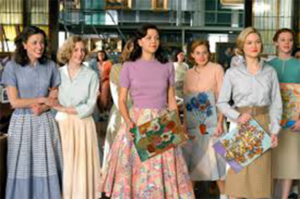
 The idea came to Lawrence Konner and me (Hey! Do NOT shout ‘It should be ‘I’ at the screen; ‘To’ is a preposition and takes the objective ‘Me’!) when the late playwright Wendy Wasserstein wrote an Op Ed piece in the New York Times with the headline ‘Hillary at Wellesley’. Hillary Clinton was Class President at Wellesley College, one of the women’s colleges — at the time — called The Seven Sisters. It was about the most forward-thinking college in the country with the legacy of graduating brilliant women. Yet, Wendy openly excoriated Hillary for ‘standing by’ Bill Clinton during his ‘blow-jobs in the White House’ crisis. Leaving poor Monica Lewinsky to the media dogs. Hillary attended Wellesley in the 1960’s but after thinking through a story set in that period, we felt it was too easy to be ‘radical’ when everyone on college campuses seemed to be. (The truth was, it wasn’t as many ‘radicals’ as we who lived then thought! Nixon won a landslide in 1968!) So, we looked father back, into 1950’s, and found the majority of these talented Wellesley women did not use their degrees professionally. They often married men who liked the idea of an educated wife who could adorn their successful lives. We asked ourselves this question: What if Hillary had arrived at Wellesley in 1956?
Quickly, almost too quickly in hindsight, we pitched the project to Julia Roberts and her producing partner, Elaine Goldsmith-Thomas. So began another example of this screenwriter’s axiom, ‘If you’re so smart, you’d learn to play dumb once in a while.’ Our first draft in August of 2001 triggered a greenlight (a ‘greenlight’, meaning they intend to try and make the movie, is also filed under the category ‘Be careful what you wish for’; that’s when the real madness begins!). We were required to visit Elaine’s office every day on 12th St. in NYC for her to oversee our ‘notes’. What are ‘notes’? Notes are given to writers usually based on feedback from various creative executives of the director; but they also come from people who think paying for a screenplay means, ‘I wrote it, too!’ So to polish our screenplay about brilliant college women at a famous eastern college, we took notes from someone who never went to college, did not read much, and had had no idea of the history of the American 50’s.
Here’s a little background. Many years ago in order to get the screenwriter’s union recognized by the studios, the original screenwriters union surrendered and gave copyright back to the studios. This is unlike the theater where the playwright owns the copyright — not one word of a stage play can be changed by the people producing the show without the writer’s permission. Ever since the writers blinked, the rule is as soon as you take one dollar from the studio or a production company they are the ‘author’ of the screenplay. You might stay with your project either because they love it and don’t want to change one word. (Right!) Or you’re the director and/or producer and you can fight back hard against studio notes. But if you’re ‘merely’ the writer and object to the changes, or if they decide they’ll never get you to do what they want, you’ll be fired and replaced by a new writer.
In this case, we knew we were in for trouble when Elaine opened her laptop and began re-writing our dialogue right in front of us instead of discussing it.
And then 9/11 happened. I was living in Bucks County, Pennsylvania, that heart-breaking day when the Twin Towers fell. The horror of the attacks stopped the re-write meetings for about a week, but then we were told to come back and keep working in Elaine’s office. They re-opened the Holland tunnel with a massive police presence but individual drivers like me had to wait till 10 AM. At times I arrived a bit too early and parked at a Dunkin Donuts to stand quietly with other drivers waiting for permission to enter the tunnel. The stench of the debacle was still in the air. No one spoke or made eye contact. Grief was the etiquette. Sometimes I would take the Lincoln Tunnel where you could still see smoke rising from the site of the terrorist attack. The producers’ offices looked down on a fire station with a garden of memorial bouquets in front of it. They had lost far too many men. When I would I drive home again at night, the smoke was ghostly against the fading light, and the monumental sense of loss made the early autumn sunset feel dolorous. It felt so strange to work on ‘entertainment’ when so many men and women gave their lives. Then again, maybe this is precisely why we make movies. Eli Wiesel wrote in NIGHT, ‘God made man because he loves stories.’
In the original draft of MONA LISA SMILE, we have one of the students throw away this line, ‘I have to go read J.D. Salinger all night!‘ This movie takes place when CATCHER IN THE RYE, the novel that changed American storytelling for the post-war generation, exploded on the scene. With its troubled teenage protagonist and angsty pre-hipster lamentations, J.D. Salinger enticed generations of young Americans to read. But Elaine simply asked, ‘Who’s Salinger? If I don’t know who he is, neither does the audience! Just say ‘I have homework.’
Now you might ask, ‘Isn’t that just one tiny detail.’ Details bundle up in a script to create tone. A name, a setting, a quip, a gun, a response, or a small action can change the tone of a film instantly and enormously. ‘Tone’ is at the heart of what is most appealing about films we love. A film like Billy Wilder’s The Apartment balances delicately between farce and tragedy. A very, very high degree of difficulty. About now you might ask, ‘Why didn’t you just walk away?‘
 This is the Devil’s Deal for most screenwriters. In general, you get paid about half your fee to write the film, but are given a ‘production bonus’ if your name stays on the project. (This involves a panel at the WGA deciding who deserves credit and I’ll have a lot more to say about that when I tell the story of THE JEWEL OF THE NILE and the two Sit Com writers who’ve stalked us for 30 years trying to sneak onto the credit of a film they didn’t write!) Even working in the most unpleasant situation, a writer wants to hang on for dear life because so much of his/her remuneration is contingent on credit. The longer you stay alive writing on a script, the greater the chance you’ll receive credit. So we bowed our heads and stayed and stayed. Even when Elaine’s horse-sized dog strolled in and without warning peed a lake of urine on the rug in the room we where we were meeting — splashing on the Manolo Blahniks of Elaine’s Creative Executive. Elaine didn’t stop for a sec — other than make one of her young assistants sop it up on his knees with paper towels! On she went with the stench all but opaque in the room. Or the time when Elaine demanded I come to a story meeting at her Upper West Side apartment at 8AM sharp one morning — meaning I had to leave Bucks County at 5AM to be safe. I stepped off the elevator on a floor with only two apartments. Knocked on her door. Fifteen minutes later she finally told me from behind the closed to wait. Another half hour passed. (That totals 45 minutes; there was nowhere to sit either.) Finally, her husband opened the door a crack and told me the meeting was cancelled. Truth is, I don’t think she eve remembered she told me to come!
Let’s go on a tangent and flash ahead over a year later when I brought my son, Harry, and my daughter, Hayley, to the set of HARRY POTTER AND THE GOBLET OF FIRE in England at the kindly invitation of the also kindly director Mike Newell, the director of MONA LISA SMILE. We arrived at the sound stage during an enormous scene with a hundred extras , so we stood quietly in the back. Mike was way up at the front, but once he spotted me he stopped shooting! Everyone watched him weave through the crew and the extras — Mike is a tall guy! — but no one could figure out where he was going. Neither could I! Until he came up and grabbed me. He took me aside to a small room where he proceeded to vent about how Elaine had wildly interfered with his directing. He told me she sat actually right by camera overruling his shots! We traded grievances. It was a delightful therapy session. The rest of our time on that set was magical. Mike actually put my kids in costume and had them be extras in a big scene in the great dining hall. Because the studio knew it was making many HP films, much of the set was real; that is, actually stone, wood, and iron, not plywood and plastic. Even all the owls were real, kept in a magnificent aviary we visited!
I invited many friends and family to a very extravagant premiere of MONA LISA SMILE in Manhattan. It was my first time seeing the completed film. Now here’s how every screenwriter watches a movie: They changed that! How could they do that!? Many times it’s a tempest in a teapot (try that expression on someone young today!). To this day many people love our film. But for me, I can only focus on two things. Remember our original theme for the film? Even at the most liberal women’s college in America, in the 1950’s women were coerced to stay at home and not use their degrees. You can imagine my reaction as the lights went down, the film came on, and the FIRST LINE of the film was this Julia Voice Over, ‘Wellesley was most conservative college in America.’ Say what? Even worse, we wrote Julia a lovely speech at the end explaining why the film is called MONA LISA SMILE. She tells the students that the Leonardo painting was not known to the general public until it was stolen once. Then newspapers around the world kept writing about how much money it was worth, and not about the painting itself. Julia’s character implores them not to become women who are known by the affluence of their married lives. She urges them to see their value as talented, intelligent, participants in any field of endeavor they wish. This was completely cut from the film. If you watch the movie today there is not one line that explains the title!. … Someone once wrote that the ‘Half-life of not-getting-the-point is forever’, and I’m not sure to this day if Elaine understands what she did. On the other hand, the After-Party at the premiere was spectacular! A Big Band played. Food and drinks aplenty! And the legendary and congenial Jeff Bridges hung out because his nephew was in the film!
Okay, is every screenwriter this whiney? Absolutely! But the truth is, Julia Roberts and the once-in-a-lifetime ensemble cast of young stars are magical in the film. Perhaps it’s the writer’s curse to see only the things that are altered, to lament the small flaws and not enjoy the finished product. Many people adore the film. In fact, people are trying to set it on stage as I write. But I can’t help thinking of those dark days of smoke and horror and driving back and forth to Manhattan alone. Always driving home like I’d spent the day being creatively Water-boarded! Then again, to be honest, the entire history of film studios includes legions of ghastly, even violent, male studio heads, sexually criminal male producers, and plain old idiot men! Elaine helped the film get produced. And until screenwriters can fund their own films, we remain at the mercy of those who hire us.